Projects

What we are building.

ARC-AGI

Solving the Abstraction and Reasoning Corpus using a cognitive architecture — not neural networks, not brute force.

What is ARC?

The Abstraction and Reasoning Corpus, created by François Chollet in 2019, is a grid-based puzzle benchmark designed to test fluid intelligence: the capacity to learn a new concept from minimal data and transfer it to an unseen situation.

Each problem presents a handful of input-output grid pairs. The solver must infer the hidden transformation rule and apply it to a new test input. No two problems share the same rule. Memorisation is useless — every problem requires reasoning from scratch.

ARC has become the target benchmark for frontier AI. Models can now reach high accuracy — but only by spending $2–$30 of compute per task. Under real-world cost constraints ($0.20 per task), the best score is 24%. The question is not whether AI can eventually grind out the right answer. It is whether it can reason cheaply, quickly, and from minimal examples — the way humans do.
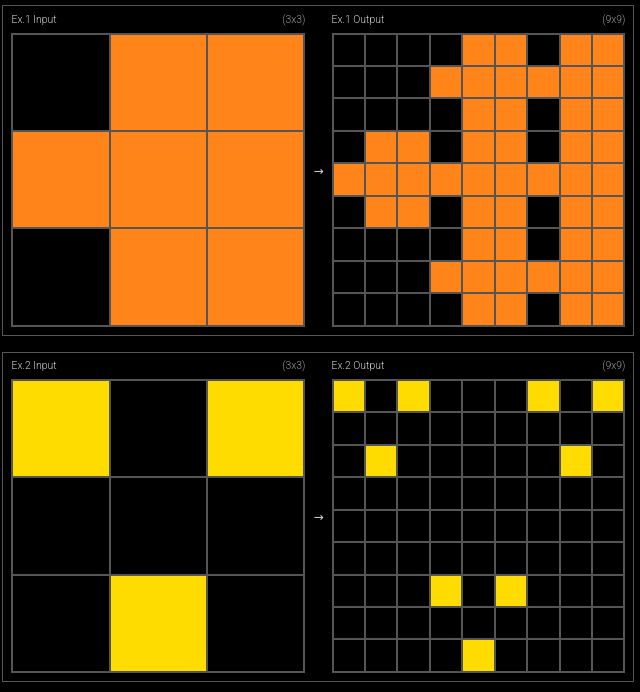
Two example ARC-AGI puzzles: a 3x3 grid mapping to a 9x9 output grid.

An ARC task: infer the rule from the input-output pairs, apply it to the test input.

A different kind of mind.

Not scaling models. Scaling insight.

Argo is a visual reasoning system that solves ARC problems using a cognitive architecture rather than neural networks. Where LLMs retrieve from frozen knowledge, Argo builds an explicit understanding of each problem from scratch: it perceives visual structures, forms hypotheses about their relationships, and constructs solutions through a process closer to how a human would reason. It doesn’t recognise answers — it constructs them.

i.

Not an LLM

No training data, no gradient descent, no GPU compute. Reasoning from the problem itself.

ii.

Extremely fast

Runs on any device — even edge computing. Inference in milliseconds, not minutes.

iii.

Auditable

Every solved problem comes with a traceable chain of perception, abstraction, and construction. Not a black box.

iv.

Cognitive models

Architecture drawn from Hofstadter’s Fluid Concepts tradition at Indiana University.

Concepts, not tokens.

Current AI systems operate on tokens — statistical fragments of text and pixels, processed through billions of parameters trained on massive datasets. They are extraordinary at pattern matching but structurally incapable of forming new concepts at inference time.

Argo operates on concepts. It perceives structure, builds hypotheses about what things mean, and reasons by analogy — the same fluid, self-organising process that allows a human to grasp a new idea from a handful of examples. Where an LLM asks “what is statistically likely?”, Argo asks “what is the underlying rule?”

The result is a system that is transparent (you can inspect every step of its reasoning), lightweight (no GPUs, no cloud), and general (the same architecture handles spatial, chromatic, and structural transformations without being explicitly taught any of them).

85% on ARC‑AGI‑1 / 2  ·  under $0.001 per task

Reaching human-level accuracy at human-level cost — the metric the industry has been avoiding.